WeMuslim: Muslim, Prayer&Qibla
- 4.2
- Rating
- 5.00M
- Installs
- Free
- Price

 Analysis by App-foxy
I approached WeMuslim: Muslim, Prayer&Qibla as an everyday companion rather than something I would open once and forget. It brings several practical Muslim life tools into one place, with prayer times, athan notifications, Qibla direction, and Quran reading at the center. That combination makes sense for anyone who wants a single app for routine worship instead of switching between separate tools.
The app sits in the lifestyle category and is developed by Metaverse Technology FZ-LLC. It is free to use, carries an Everyone age rating, and supports devices running Android 6.0 or later. In the store, it has built a 4.5 average from around 13 thousand ratings and passed 5 million installs, which suggests that its all-in-one approach appeals to a broad audience. I still think the more useful question is not how popular it is, but whether its daily workflow fits the way you pray, read, and plan your day.
How WeMuslim fits into a real daily routine
The strongest idea here is convenience. Instead of treating prayer times, the call to prayer, Qibla, and Quran access as unrelated utilities, the app places them under one roof. That matters most during busy days: I can imagine checking the next prayer before leaving work, confirming direction in an unfamiliar place, and opening a Quran passage without searching for another application.
You May Also Like

 Blood Strike: 2.5 Anniversary
Blood Strike’s Loadouts Turn Every Drop Into a Tactical Gamble
A close look at Blood Strike’s custom loadouts: how fast access to signature weapons reshapes its battle royale rhythm, rewards preparation, and narrows the gap between fights.

 Pandora - Music & Podcasts
Pandora’s Music Is Easy to Start, but Harder to Recover
Pandora’s strength is its low-effort path from a seed to a station. Its weak spot is how much confidence it asks you to place in connection, setup, and quiet recovery.

 8 Ball Pool
 Is Built on Rivalries, Rematches, and Routine
A close look at the rivalries, rematches, shared routines, and unanswered safety questions that turn a quick pool match into a persistent mobile community.

 Samsung Music
’s Quiet Strength Is Playing What You Already Own
Its reach comes less from spectacle than from dependable access to a personal library. That simplicity is both the app’s strongest retention engine and its ceiling.

 AccuWeather: Weather Radar
AccuWeather Review: A Quick, Clear Forecast for Everyday Decisions
For everyday plans, the best forecast is the one you can understand quickly. AccuWeather makes rain timing, radar, and local conditions easy to act on, with a few trade-offs.

 Hill Climb Racing
Why Hill Climb Racing Still Turns Crashes Into One More Run
A tiny car, a bumpy hill and one more upgrade: Hill Climb Racing keeps resurfacing because its simple chaos makes every near-miss feel personal.
More From Our News Desk



That convenience is particularly useful for people who travel, move between home and work, or are still building a consistent prayer routine. A separate app for each task may offer a more specialized experience, but it also creates more setup, more notifications to manage, and more chances of forgetting which tool does what. WeMuslim reduces that friction by keeping the main religious utilities together.
The prayer-time side is likely to become the part you use most often. A schedule is valuable only when it matches your local circumstances, so I would take time during the first setup to check the location and calculation choices carefully. Prayer calculations can vary by region and convention, and a difference of a few minutes can matter. I would not simply accept the first displayed schedule without comparing it with the timetable used by your local mosque or community.
That comparison is one of my most important practical recommendations. If the app and your mosque disagree, the issue is not necessarily that one is “wrong”; they may be using different calculation methods or adjustments. Treat the first day as a calibration step. Once the schedule looks right for your area, the app becomes much more dependable as a daily reminder.
Notifications are useful only when they stay under control
Athan alerts can turn the app from a reference tool into a genuine routine aid. They are helpful when you are absorbed in work, commuting, studying, or handling family responsibilities. A timely reminder can prevent prayer from disappearing into a crowded day, especially when you do not have a mosque timetable in front of you.
At the same time, notifications need personal judgment. A sound that is appropriate at home may be awkward in an office, classroom, hospital, or public transport. I would begin with alerts that suit my schedule and surroundings rather than enabling every possible reminder immediately. Silent or less intrusive notifications may be the better choice during working hours, while a fuller athan alert can make more sense when I am at home.
This is also where the app may feel less seamless than a dedicated reminder tool. A focused prayer app can sometimes offer more granular control over notification behavior, while an all-in-one application asks you to balance several kinds of content and alerts. WeMuslim is more convenient overall, but convenience does not automatically mean maximum control.
Qibla guidance is most valuable when you understand its limits
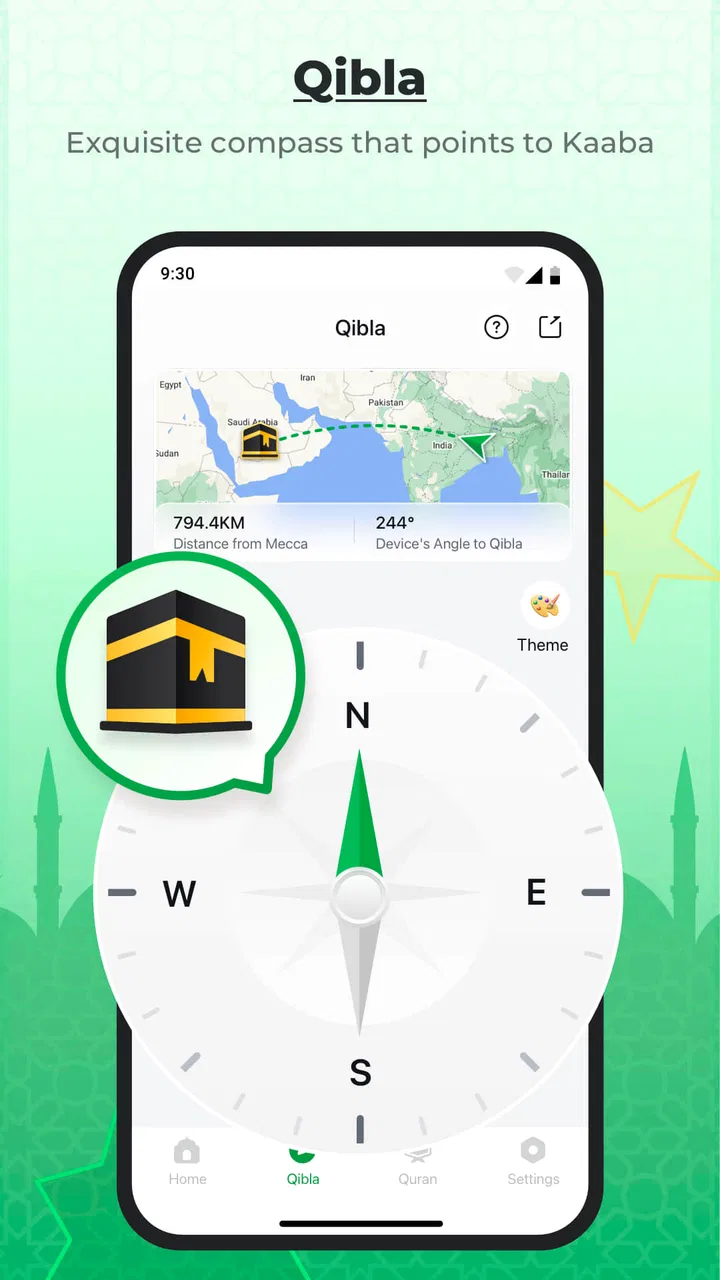
The Qibla feature is a practical reason to keep the app installed, especially when staying in a hotel, visiting another city, or praying somewhere unfamiliar. I would use it as a quick orientation aid, then place the phone on a stable surface and check that the direction is not being affected by nearby metal objects or an uncertain compass reading.
Phone-based direction tools deserve a little patience. If the arrow behaves strangely, I would move away from large electronics and metal furniture, then recalibrate the device rather than assuming the app itself has failed. This small habit is easy to overlook, but it makes the feature more useful in real situations.
There is a trade-off here compared with a dedicated compass or a local mosque’s established direction. WeMuslim is convenient because the Qibla tool lives beside the prayer schedule and Quran, but a specialist navigation app may provide a more detailed orientation experience. For most everyday checks, the integrated approach should be enough. For a new building or a particularly important setting, I would verify the direction instead of relying on one phone reading without thought.
Quran access makes the app more than a notification panel
The Quran component gives the app a quieter use case. Prayer reminders are time-based, but Quran reading can happen whenever the day allows: during a calm morning, after prayer, while commuting if conditions are safe, or during a short break. Having the text close to the prayer tools encourages a more complete routine than an app that only sends alerts.
I see this as especially helpful for someone who wants to start reading more consistently but does not want to manage a separate Quran application. The lower barrier matters. When the next step is already visible inside the same app, a few spare minutes are less likely to become an excuse to postpone reading.
Still, readers who need a highly specialized study environment may prefer a dedicated Quran app. Serious study can involve detailed search, bookmarking, notes, translations, recitation controls, or a particular edition. I would choose WeMuslim for convenient access within a broader Muslim lifestyle toolkit, not automatically as a replacement for every specialized Quran resource.
What the free price means in practical terms
The clearest value point is simple: WeMuslim is free. That makes it easy to try without committing money first, and it lowers the risk for someone who wants prayer times, Qibla, and Quran access in one place. For a free lifestyle app, the strongest benefit is not a single dramatic feature; it is the amount of everyday friction removed by combining several familiar needs.
I would still separate free access from unlimited personal value. An app can cost nothing and still demand time to configure, attention through notifications, or patience when its settings do not match local practice. The right way to judge WeMuslim is therefore to use it for a few ordinary days: check whether the prayer schedule aligns with your trusted local reference, see whether alerts arrive at useful moments, and decide whether the integrated Quran and Qibla tools actually replace apps you already use.
Because the app is free, the decision is less about calculating a purchase and more about deciding whether it deserves a place on your phone. If it replaces two or three separate utilities without creating new confusion, its practical value is strong. If you already have a carefully configured prayer app, a preferred Qibla tool, and a Quran reader you enjoy, the free download may still be unnecessary rather than automatically beneficial.
I would also avoid judging the app only by its store popularity. Its 4.5 average and broad install base are reassuring signs that many users find it useful, but they do not guarantee that its prayer calculations, notification style, or reading experience will suit your location and habits. Religious routines are personal, and local accuracy matters more than a general popularity signal.
A realistic day with the app
Imagine starting the morning at home, checking the first prayer time, and leaving for work with the next reminder already in mind. At lunchtime, the notification appears while you are in a busy office, so you use a quieter alert style rather than a full sound. Later, you travel to a friend’s home in an unfamiliar neighborhood and use the Qibla tool before praying. On the way back, you open the Quran section for a short reading session.
That scenario shows where the app earns its place. None of those tasks is revolutionary on its own, but they are connected by the same daily rhythm. The advantage is not having to remember four application names or search for a missing tool. The drawback is that one application becomes responsible for several different jobs, so a weakness in setup or notification handling affects more of the experience.
Where the all-in-one design can create friction
The biggest limitation is the need for careful personalization. Prayer times are not a universal fixed schedule, and users may follow different local conventions. If you are expecting the app to be accurate without checking its location and calculation setup, you may be disappointed. I consider this a normal responsibility for any prayer-time application, but it is still a step that beginners may not anticipate.
The same applies to Qibla. A phone compass is convenient, but it is not magic. Device calibration, surroundings, and how the phone is held can affect confidence in the result. WeMuslim makes the tool accessible, yet accessibility should not be confused with professional navigation precision.
There is also a possible focus issue. Someone who only wants a lightweight prayer timetable may find the Quran and Qibla sections useful additions, or may see them as extra layers around a simple need. Conversely, someone seeking deep Quran study may find the broader lifestyle approach less focused than a specialist reader. The app’s strength and weakness come from the same design decision: it tries to cover several connected needs instead of perfecting just one.
Another trade-off is habit dependence. An app can remind me that prayer time has arrived, but it cannot decide where or how I will pray, resolve local scheduling questions, or replace personal discipline. I would use WeMuslim as a support system, not as a substitute for community guidance or my own routine.
How it compares with separate alternatives
Compared with a dedicated prayer-time application, WeMuslim offers a broader starting point. I get the schedule, athan support, Qibla access, and Quran reading in one installation. That is the better arrangement for someone who values simplicity and does not need advanced controls in one narrow area.
A dedicated prayer app may be preferable when exact calculation customization, highly detailed alert rules, or a minimal interface matters most. If your current prayer tool already matches your mosque’s timetable and you have spent time refining its reminders, switching merely to consolidate apps may not improve your day.
Compared with a standalone Quran reader, WeMuslim is more convenient for occasional or routine reading connected to prayer. A specialist reader may be the stronger choice for intensive study, especially if you depend on a particular translation, recitation workflow, or research feature. I would keep both only if the difference genuinely supports two distinct habits; otherwise, the all-in-one approach may be enough.
Against a separate compass application, the integrated Qibla tool wins on convenience rather than depth. It is there when I need it, without another installation or a separate search. But users who regularly navigate, travel extensively, or demand more orientation detail may prefer a dedicated tool and use WeMuslim mainly for worship-related routines.
Who is likely to get the most value
I would recommend trying WeMuslim if you are looking for a free starting point that combines the essentials. It is particularly suitable for someone setting up a new phone, a person who travels between familiar and unfamiliar places, or anyone tired of juggling separate prayer, compass, and Quran applications.
It also makes sense for users who benefit from visible structure. The next prayer provides a natural anchor for the day, while the Qibla and Quran tools support what happens around that anchor. New users should spend a few minutes validating the schedule and choosing notification behavior instead of treating installation as the end of setup.
I would be more cautious if your needs are highly specialized. Someone who follows a very particular local prayer timetable, wants extensive calculation controls, or studies the Quran through advanced tools may be happier with dedicated alternatives. The app is not a poor choice in those cases, but its broad scope may feel less precise than a purpose-built solution.
It may also be the wrong fit for anyone who dislikes frequent notifications or prefers a paper timetable and a physical Quran. Digital convenience is only useful when it supports your habits. If phone use distracts you during worship, the app’s range of tools could become more interruption than help.
Version, compatibility, and the decision to try it
The current version is 1.4.1, and the app was released on May 30, 2025. It supports Android 6.0 and newer, so compatibility should cover many older Android phones as well as recent devices. That broad operating-system reach is helpful for families or users who do not replace phones frequently.
My advice would be to install it with a clear test plan rather than expecting an instant verdict. First, confirm that the displayed location is correct. Next, compare the prayer schedule with a trusted local source. Then adjust the athan behavior for your home, workplace, and travel patterns. Finally, try the Qibla and Quran sections in the situations where you would genuinely use them.
That process answers the questions that matter most: Will the times fit my community? Are the reminders comfortable in my environment? Is the compass dependable on my phone? Does the Quran access encourage reading, or do I already prefer another reader? Since the app is free, this hands-on check costs no purchase price, but it does require a little attention.
My final view is favorable, with sensible limits. WeMuslim delivers a useful bundle for people who want core Muslim life tools together, and its free access makes experimentation easy. I especially like the way a single routine can connect prayer timing, reminders, Qibla orientation, and Quran reading without forcing me to maintain several separate apps.
My recommendation is to try it if convenience is your priority, then keep it only after checking the schedule against local practice. It is not automatically the best choice for advanced Quran study, highly customized prayer calculations, or users who already have perfectly matched specialist tools. For everyone else, the balance is compelling: a practical lifestyle app with meaningful daily value, provided I treat its settings as something to verify rather than something to accept blindly.
FAQs for WeMuslim: Muslim, Prayer&Qibla
01What is WeMuslim: Muslim, Prayer & Qibla, and what features does it offer?
WeMuslim is an Islamic lifestyle app designed to help users organize daily religious practices in one place. Its main tools generally include prayer times, Qibla direction, Quran access, supplications, Islamic calendar information, and reminders. Depending on your location and selected settings, the app may also provide fasting-related information, nearby mosque details, and other educational content for everyday use.
02How accurate are the prayer times and Qibla direction in WeMuslim?
Prayer times are calculated according to your location, calculation method, time zone, and selected legal school, so accuracy depends on configuring these options correctly. When reviewing the app, users should allow location access or enter their city manually and compare the schedule with a trusted local mosque. Qibla guidance also works best outdoors with location and device sensors enabled.
03Does WeMuslim require an internet connection to work?
Some WeMuslim features may continue working without a constant internet connection after the necessary data has been loaded, including saved prayer schedules or previously opened Quran content. However, internet access may be required for location updates, fresh prayer calculations, online content, advertisements, account synchronization, or nearby mosque information. Downloading or updating content before traveling is recommended.
04Is WeMuslim free to download, and does it contain advertisements or in-app purchases?
WeMuslim can generally be downloaded at no initial cost, but the exact availability of premium features, advertisements, or subscriptions may vary by platform and region. Before installing, check the Google Play Store or Apple App Store listing for current pricing and purchase details. Users should also review whether paid options are needed to remove ads or unlock additional tools.
05Is WeMuslim suitable for Ramadan and daily Islamic practice?
WeMuslim can be useful during Ramadan because prayer schedules, fasting-related timings, Quran access, supplications, and reminders may help users maintain a consistent routine. Nevertheless, calculated times can differ from local official announcements, particularly for fasting and Eid dates. For important religious observances, it is wise to confirm the app’s settings and compare its information with a recognized local authority.
Pros
- Accurate prayer times with multiple calculation methods for different regions.
- Qibla compass works offline and helps locate the direction quickly.
- Includes Quran reading tools alongside translations and audio recitations.
- Useful Ramadan features such as fasting schedules and daily reminders.
- Clean interface makes key Islamic tools easy to find and use.
Cons
- Some advanced features may require a premium subscription.
- Prayer-time accuracy depends on correct location and calculation settings.
- Frequent notifications may feel excessive for users preferring a quiet app.
- Audio recitations can consume considerable mobile data when streamed.
- The app may request location access
- which privacy-conscious users may avoid.

WeMuslim: Muslim, Prayer&Qibla
Gallery